Pages

Thursday, July 24, 2008

Pyramid of Shadows


4th Edition D&D adventure for characters of levels 7–10

The ancient trees of the Shadowsong Forest have borne witness to the passing of epochs, and hidden beneath their dark canopies are the remains of empires long departed. Few souls brave enough to explore the primeval forest ever return, for countless horrors haunt the crumbled ruins. When a band of evil criminals seeks refuge within the darkest reaches of the forest, brave adventurers are needed to root them out. The trail leads to the heart of the woods, wherein looms the greatest secret of all — the Pyramid of Shadows.

Tuesday, July 22, 2008

Core Rule book Errata For 4th edition

Here are the most recent errata for 4th edition core rules. ERRATA

Play Living Forgotten Realms

From Enworld

Player's Guide to the Forgotten Realms: Swordmage, Drow, Genasi & Backgrounds
The Living Forgotten Realms has gone live, and we get the Character Creation Guidelines and a preview PDF of Player's Guide to the Forgotten Realms, which has Swordmage's to level 3, Drow, Genasi & Regional Backgrounds!


Creating your own character for Living Forgotten Realms is about as straightforward as creating a character for any other D&D campaign. In fact, you could simply follow all the rules in the Player’s Handbook to create your new 1st-level LFR character (just remember to use Method 1 or 2 for ability scores). However, there are some additional features that Living Forgotten Realms characters have that you might be interested in knowing about when you create your character.

Read the RPGA Character Creation Guide
Your first step to making a Living Forgotten Realms character is to download the RPGA Character Creation Guide (zip/pdf 279 KB). This document has all the rules for making characters for RPGA play. The Living Forgotten Realms campaign has a special appendix in the document; simply read the general section and then flip to the rules for LFR. Don’t forget to choose a region for your character, as that may have an impact on your upcoming adventures!


Grab a Character Sheet
You can download a character sheet from the Wizards site, or you can purchase a pack of Character Record Sheets from your local store. The pack also contains the very handy power cards so you can keep all your powers right at your fingertips rather than flipping through books during your game session.

Print Out the Adventure Log and Advancement Tracker
Attached to the RPGA Character Creation Guide (zip/pdf 279 KB) is an adventure log and advancement tracker. You’ll want to print out a copy of each of those pages when you play your first session. You’ll use them to keep track of essential notes as your character adventures throughout Faerûn.


Check Out the Forgotten Realms Player’s Guide Preview!
Want to play a swordmage? A genasi? Or how about a drow? Download the preview material (zip/pdf 205 KB) and get a taste of what’s to come in the Forgotten Realms Player’s Guide, due out September 16, 2008!


Monday, July 21, 2008

3.5 to 4th edition conversion

This is a post for all those who have not seen the conversion for 4th edition and have characters they wish to bring to the new game rules.

When it comes to converting characters from 3.5 to 4th Edition, we’ve previously stated that “there's no conversion guide that could adequately cover the vast array of options that have been published over the lifespan of the game.”

That said, we also recognize that if you don’t wish to set aside your favorite character in order to start up a new 4th Edition campaign, some amount of conversion will be attempted. To that end, Andy Collins put together the following recommendations for playing your favorite 3.5 character in 4th Edition.

This week, we look at those classes from the 3.5 Player’s Handbook.
Player’s Handbook v.3.5
Barbarian


Most barbarians fit best into the great weapon fighter build (p76), though barbarians wielding a pair of weapons should instead consider the two-blade ranger build (p104). Note that the former build slots you into the defender role and the latter into the striker role, so be sure you’re happy with the destination.


Either way, feat selection can also be useful in helping recreate your former identity. For example, Power Attack is still good for the greataxe-wielding barbarian, while Toughness replicates your d12 Hit Dice. Fleet-footed gives back some of your speed boost, and Blood Thirst certainly feels appropriate for the savage barbarian.


4th Edition doesn’t yet offer a rage mechanic to mimic the 3E barbarian’s iconic class feature, so you and your DM will need to get a little creative if you want to retain that flavor. For example, perhaps once you use Power Attack, you can’t stop using it until the end of the fight (but it gives you an extra +1 damage). Or perhaps you can just announce at any time: “I’m taking +4 melee damage at the cost of -2 AC for the rest of the encounter.” Whatever you come up with, keep it simple and easy to use… and keep your eyes open for barbarian class previews on D&D Insider later this year.


Bard

In 4th Edition terms, the bard would likely be an arcane leader: that is, a character who uses arcane spells to keep his comrades healthy and boost their combat efficiency. The 4E Player’s Handbook doesn’t offer a perfect translation of this character—the 4E bard is slated for future publication—so you have two basic options:

1. Focus on your leader abilities, selecting either the inspiring warlord or tactical warlord build (p144). Recast the flavor of your powers from bold commands and exhortations to inspiring songs or odes. Select one or more wizard or warlock multiclass feats (p209) to pick up a selection of arcane spells with bardic flavor (such as beguiling tongue, otherwind stride, sleep, or invisibility).


2. Focus on your arcane powers, translating your character into a control wizard (p157) or a deceptive warlock build (p130). Select one or more warlord multiclass feats to recapture some of your team-boosting powers. With your DM’s permission, you can even call these powers “arcane spells” if you want.

Cleric

The cleric is one of those 3rd Edition classes that had the ability to cover multiple roles—sometimes simultaneously—which means 4th Edition had a mandate to bring the class in line with the other characters of the party. No longer can your 4E cleric tank as well as a fighter, blast as well as a wizard, and still heal better than anyone else in the game; in other words, be prepared to give up some of that super-versatility (believe me, the rest of the players in your group will appreciate it).


As leaders, 4E clerics are now defined first and foremost by their ability to support the entire party via healing and buffing. That said, clerics haven’t given up the ability to stand up to attacks or blast the monsters—they just don’t overshadow their comrades when they do so.


The traditional, “generic” cleric of 3E matches most closely to the devoted cleric build (p61) in the 4th Edition Player’s Handbook, which focuses on keeping your allies healthy and optimized. If your cleric prefers to mix it up in melee with the monsters, you should choose the battle cleric build (p61); or, alternatively, one of the paladin builds if you want to move formally into the defender role.

Druid

The druid’s still waiting for her big debut on the 4th Edition stage… so until then, you’re probably best off reimagining your character as a cleric of a nature-friendly deity (such as Corellon, Melora, Pelor, or Sehanine) and choosing either the battle cleric or devoted cleric build (p61).


This still leaves a lot of druid class features out of your grasp, but with your DM’s permission, any or all of the following tweaks might help you retain some of your druidic flavor:

1. Gain automatic skill training in Nature instead of Religion, and use Nature in place of Religion for all aspects of ritual casting.


2. Gain fluency in Druidic, a secret language known only to druids.


3. Change the damage type of your cleric prayers to fire or to lightning.


4. Replace divine fortune from your list of Channel Divinity options with the ability to speak with beasts for the rest of the encounter, and/or replace turn undead with the ability to briefly take bird form and fly up to 8 squares as a standard action (returning to normal form at the end of the move; your stats don’t change during the move).

Fighter

It’s easy to assume that your 3E fighter should just use the new 4E version of the class, but before you do that you should ask yourself about your preferred style of play. Does your fighter stand in the middle of the fight, taking on every monster that comes his way, relying on his high AC and hit points to see him through? If so, then you sound like a traditional defender, and you should choose either the great weapon fighter or guardian fighter build (p76), depending on whether you wield a two-handed weapon or a weapon and shield.

On the other hand, if you built your fighter to be a high Dexterity, two-weapon-wielding engine of destruction, you might be happier using the two-blade ranger build (p104) than either of those fighter builds. And if you’re one of those fighters who disdained melee combat entirely in favor of a good ranged weapon, then the archer ranger (p104) is your likely best bet. It’s even possible that the brawny rogue build (p117) might be the optimal choice for you (particularly if you also picked up a couple levels of rogue along the way).

Monk

At a glance, the player with a 3E monk might think that he’s out of luck until the 4E monk releases—there’s no unarmored, unarmed melee fighter option anywhere in the Player’s Handbook. However, with your DM’s permission you can create a martial-arts striker who captures much of the monk’s style by following this process:

1. Choose the two-blade ranger build (p104). (Don’t worry, this will make sense in a minute.)


2. Give up your leather and hide armor proficiencies, gaining a +3 bonus to AC when wearing no armor or cloth armor. You’re now only a point behind the normal ranger’s AC.


3. Gain a +2 bonus to Will defense (in addition to the ranger’s normal defense bonuses).


4. Replace Dungeoneering and Nature on your class skill list with Arcana, Diplomacy, Insight, and Religion. Choose five trained skills from your class list.


5. Give up your martial weapon proficiencies. Grant your unarmed strike a +3 proficiency bonus, increase the damage to 1d8, and add the off-hand property. Now you’re wielding two melee weapons that are as good as the martial melee options available to the ranger.


6. Rename Hunter’s Quarry as Monastic Battle Focus, and lose the Prime Shot class feature. (You thought you were getting that +2 bonus to Will for free, didn’t you?)


7. Focus on mobility-oriented powers, particularly those that reward a high Wisdom score (such as evasive strike, yield ground, and weave through the fray). As desired, you can rename those powers with a flavor that befits your monkish heritage (peerless balance of the crane instead of fox’s cunning, for example).


8. Pick up feats to recreate other 3E monk class features—Evasion, Fleet-Footed, Long Jumper—and use multiclass feats (p209) to replicate the supernatural features. For example, the warlock has several teleportation powers reminiscent of abundant step.

This doesn’t faithfully recreate every element of the 3E monk, but it’s definitely a reasonable stopgap if you’re really committed to sticking with the character. Feel free to experiment with additional tweaks, and by all means please share your results on the D&D message boards!

Paladin

Of all the classes in 3rd Edition, the paladin might be happiest to see his new incarnation in the 4E Player’s Handbook. Gone is the weak nod to divine spellcasting, replaced by the wide variety of divine smites and smashes that now define the class. That’s not to say that you’re a one-track defender; you still have lay on hands, and a range of utility and daily powers retain just enough of the classic paladin’s “backup leader” flavor. Your ability array will point you either to the avenging paladin (high Strength) or the protecting paladin (high Charisma) build (p90).

If your 3E paladin felt more like a leader than a defender, the battle cleric build (p61) might be more your speed… or maybe you just need the Initiate of the Faith and a couple of power swap multiclass feats (p209) to gain cleric powers in place of your paladin prayers.


There’s no option for a paladin’s mount in the Player’s Handbook; instead we gave the paladin a few utility powers that can move him across the battlefield quickly to his allies’ aid (such as benign transposition, radiant charge, and angelic intercession).
Ranger


Just as in 3rd Edition, the 4E ranger offers two distinct combat styles, making it easy for you to identify the right build for you. If you favored two-weapon fighting, take the two-blade ranger build (p104); archers should select the archer ranger build (p104).


However, 4th Edition intentionally removed two familiar but decidedly second-tier ranger class features—spellcasting and the animal companion. The ranger now sits firmly alongside the fighter and rogue as a non-spellcaster, and he doesn’t bring along four-legged cannon fodder.

You can recapture some of the divine spellcasting flavor of your previous ranger (assuming you gained enough ranger levels for spellcasting to be noticeable). Pick up Initiate of the Faith (for one healing word per day) and one or more power swap feats (p209) for other cleric powers. There’s no option in the Player’s Handbook for a ranger animal companion, however… but rangers missing their pets should check out the Martial Power sourcebook, releasing October 2008.

Rogue

Most 3E rogues fit very easily into the 4E rogue class, choosing either the brawny rogue or trickster rogue build (p117) based on their ability scores and skill preferences—the former for high Strength, climbing and jumping rogues, the latter for high Charisma, fast talking rogues.


That said, there are some viable 3E rogue builds that fit better into the 4E ranger class. If your rogue wields two weapons, you can either choose feats to support that style or go whole-hog by using the two-blade ranger build (p104). And if the whole idea of melee combat repulses you, the archer ranger build (p104) is probably more your speed. (In either case, a few multiclass rogue feats (p209) will help you recapture your sneaky identity.)

Sorcerer

Beyond their mechanical methods of gaining and expending spells, the sorcerer and the wizard effectively did the same thing—drawing from the same spell list, for example—and thus you face the same decisions as the wizard player does (see the Wizard, below). Unlike the wizard, however, it should be easier for you to identify your character’s spell preferences since you’ve been using the same subset of spells over and over again for most of your career.
Wizard


Yes, you have a new version of your class in the Player’s Handbook… but that doesn’t mean you’ll be able to translate every single one of your spells. Like a few other classes, the 4E wizard has a narrower range of power options than the 3rd Edition wizard. Some of these powers are coming later (summoning and illusions, for example), while others simply aren’t appropriate for the character role. Wizards don’t have a lot of party-buffing spells, for example; that’s more appropriate for leaders than for controllers. Taking those spells off the wizard list helps keep that class from overshadowing other characters in the party (see the Cleric, above).


If your 3E wizard focused on area-damage spells such as fireball, lightning bolt, and cone of cold, the war wizard build (p157) is for you. On the other hand, if you preferred spells that hampered your enemies’ ability to move freely and act effectively (such as ray of enfeeblement, stinking cloud, and slow), you’re better off with the control wizard build (p157).


Some 3E wizards might actually find the warlock class more to their liking—particularly if they fancy themselves more as “single-target killers” than battlefield controllers. If your 3E wizard is defined by his scorching ray, vampiric touch, enervation, and similar one-target ranged attacks, check out either the scourge warlock or deceptive warlock build (p130).


Well folks, that covers the 3.5 Player’s Handbook. Join us next time for a look at classes from Complete Adventurer!


About the Author

Andy Collins works as the system design and development manager for D&D at Wizards of the Coast. His development credits include the Player's Handbook v.3.5, Races of Eberron, and Dungeon Master's Guide II. He is also one of the lead designers for 4th Edition D&D, along with Rob Heinsoo and James Wyatt.

Wednesday, July 16, 2008

So is Dungeons and Dragons More like Magic?

I get this feeling that I am playing Magic the Gathering sometimes while playing this latest incarnation of Dungeons and Dragons. 4th edition seems like Wizards has decided to merge Magic into the Dungeons and Dragons.

So is this a bad thing or a good thing? What's your opinion?

Thursday, May 8, 2008

Side Treks from Dungeon

To check out more on these adventures go to Wizards.com. You will need to register to get the downloads.
Each year in the village of Steeplefall, the villagers celebrate the Day of the Straw Men. A villager must merely whisper his or her sins to the small effigy, then burn it in a massive fire at the town square to be scoured clean.

But someone has an ulterior motive at this year's burning. After the PCs have had a chance to enjoy the festivities, at the evening's bonfire, a dark power strikes. Can the characters save the festival and the innocent townsfolk in attendance? Even if they do, who or what was behind the attack?

Tuesday, March 11, 2008

You will be Missed Gary

I was very saddened today to find out that Ernest Gary Gygax passed away. He was such an inspiration to, a generation of gamers. He co-created one of the best games of all time Dungeons and Dragons. I was fortunate to have met him and one of many who got to sit in on some games he DMed. You will be missed greatest of all Dungeon Masters. I wish condolences to family and friends.

-Eric
clipped from www.wizards.com
blog it

Monday, January 14, 2008

Planescape Session 1

You are floating through oblivion. Everything is quiet in the never ending darkness. Brief images appear to you in the void and quickly fade away. Obscure images they are, of warm hearth fires & fresh baked bread and beautiful landscapes of trees and rivers. Some scenes include the specific individuals but you don’t know if they are friend or foe. Some of these beings seem vaguely familiar, others completely unknown. A few of the scenes include shining crystals and otherworldly landscapes.
Soon the fires of the hearth grow cold and the bread begins to mold and rot. The forests burst into flames and hordes of demonic soldiers begin marching to war. You see the individuals suffer and die horrific deaths. Blood and torture follow all of the twisting scenes but you have no feeling or concern of that here in the dark emptiness. Accompanying some of them are faint whispers but you can’t make out what they say. Are they memory or visions? You cannot be sure.
Somewhere beyond the images in the depths of darkness are two yellow ovals. Perhaps they are eyes watching. You care not. No feelings, desires or pain exist here.
Eternity passes and you continue in quiet existence. Then the whispers begin to get louder. Images of fiends battling become more frequent. The whispers become talking, then loud screams of pain. The blasts from explosions make the dark void shake! Something is happening around you!
With a gasp you reach consciousness and your eyes flare open to a blinding red light followed by a thunderous boom! While you try to blink away your light blindness, you can hear a battle raging and inhuman screams echoing very close. Another flash of light sends a wave of scorching air over your body making it hard to breathe. With horror you realize that you are strapped down and cannot move your arms or legs.
As your eyes begin to adjust, you begin to realize that you are in some sort of dank, torch lit, grey stone chamber. A scan of the area shows that this is some sort of bizarre laboratory filled with a clutter of alchemical equipment. Other beings, some unmoving, are strapped to the same type of bloodstained stone tables that you now realize you lie on. Everyone is clothed in only dirty, torn breeches and have nasty scars, stitches and bruises on their bodies. Your brain aches trying to make sense of it all but you cannot remember who you are or how this came to pass.
Another loud crash and gurgling screams issue forth from behind a huge solid iron door in the far wall of the room. A series of metal bending thunks echo through the room and the shape of large, clawed fingers begin to form and push their way through the door! Two black, razor sharp claws pierce the iron and begin to bend and rip it back to form a jagged hole.
More horrid screams echo along with the clang of steel. The huge claw retreats from the door and the sound of ripping flesh and breaking bones follows. With a final blood curdling shriek, you hear a squishing slap followed by a deep, throaty roar that reverberates through your skull. In an instant another fiery eruption releases beyond the door with such a force that the center of it folds inward, nearly breaking off its hinges and jets of white hot flame pour into the room through the gaps in the frame and clawed holes! The force blasts over tables, destroying equipment and the room becomes a furnace while you feel your skin begin to burn and blister. The taste and smell of brimstone invades your mouth and nose and you begin to suffocate as your lungs burn.
Thankfully, the heat quickly subsides and so do the sounds of battle. All is eerily quiet except for crackling fires now burning items on the tables nearest the door. Shadows dance around the room from the flames, but otherwise no movement can be seen.

Thursday, December 6, 2007

Dungeons and Dragons for Almost nothing to free.

With the 4th edition of Dungeons and Dragons around the corner many of us gamers will be purchasing this new edition when it comes out. I know I will and I am glad I have a Paypal account that is set up as a money market also.

I came up with this plan because I will be spending my money on the new products. Only I want to do it in a cost effective way and I would like to earn some money along the way.


Paypals money market account is easy to set up just say yes to that option as a member of Paypal. PayPal Money Market; 30 day yield 4.70%; Min Invest None; Web address paypal.com; Phone number 402-935-7733. The 30 day yield means you will get paid this interest every 30 days.


I have decide to put $35 dollars in my Paypal money market every time I get paid because that is the estimated price of new books. After 30 days I earn $1.65 ( 35 X 4.70% = 1.645 + 35 = 36.65). Now I get paid bi-weekly so $70 dollars a month x 4.70% = 3.29 + 70 = 73.29. The other great thing, is compounded interest so $70 + $73.29 = $143.29 x 4.70% = $6.73 + 143.29 = $150.02. By May you should have earned $57.54 in interest that equals about 1 1/2 books.

Imagine what you could do if you just kept on going build it up to $900 x 4.70% = 42.30 thats a book a month basically for free.
You could do this with new video game releases or systems you could keep on growing that money market and pay for just about anything with the interest earned.

The downside is that you do have to pay taxes because on the interest you earn because it is consider income.

Give it a try and let me know what you thing.


Sunday, November 11, 2007

Danger in the Wilderness: Steal This Hook

From Wizards

Wolf at the Door -- Forgotten Realms

Thesk straddles the western end of the Golden Way, the trade road that connects far-off Kara-Tur with the main part of Faerûn. Because of this, Thesk is a very wealthy nation and handles a lot of trade. "I want you to go to Two Stars," says the woman seated across from you. "I have a certain property coming in on a caravan from Shou Lung, and I would like to have it 'diverted' from the Golden Way before it reaches Telflamm and gets taxed. All you have to do is meet with a merchant named Beavom Tastald and give him this, and he will give my package into your keeping. Take it south on the Cold Road into Nethentir and meet the Spry Jewel of the Sea. The captain will take it off your hands."

Assuming they agree, the PCs find themselves traveling the Golden Way toward Two Stars in very wintry weather. It is unseasonably cold, so much so that trade has been slowed on the Golden Way through Thesk and Rashemen. The farmers curse the weather because crops have been ruined (assuming you place this adventure in a season other than winter). And to top off everything, reports of monsters in the wilderness increase as one travels eastward from Phsant.

About a day's journey from Two Stars, the PCs come across the remains of six people and two large wolflike creatures. The people have been eaten to the bone, their possessions lie scattered around and hidden underneath the snow; to their credit, they apparently took down two of the wolves before succumbing to the rest of the pack.

In Two Stars, the PCs find that the caravan they are waiting for has been delayed, or at least that it has not arrived yet. While they wait, they may encounter the following possibilities:

d100 Adventure Directions

00-50 At the Crossroads Tavern, a member of the Gallidy family sees the PCs and tries to hire them to determine where the monsters are coming from. Monsters are bad for business.

51-80 Beavom Tastald notes the PCs' interest in the delayed caravan, and he offers to pay them to travel the Golden Way and find it, or at least discover what happened to it. This leads the PCs into Rashemen, where they are attacked by winter wolves.

81-00 A farmer in Two Stars, or encountered along the road, could ask the PCs to find a missing relative (who has been mauled by winter wolves).

d100 Story Elements

Choose or randomly generate story elements from the table below, or make up your own.

00-40 Winter wolves from the Sunrise Mountains in Rashemen have expanded their range into Thesk because of the unusually strong winter storms. Packs of them ravage the countryside and eat farmer and merchant alike. If the winter subsides, the wolves would retreat to their normal range.

41-55 The storms center in northern Rashemen and are not natural. Wizards are causing them, and the spread of winter wolves is an accidental side effect.

56-70 Winter wolves are not the only monsters to spread into Thesk. Remorhazes, cold worms, frost giants, and other fell creatures pose dangers to the residents of Thesk and Rashemen.

71-95 The caravan carrying the package the PCs are to pick up has been attacked by ravaging winter monsters, and the package has been taken by frost giants into the Sunrise Mountains.

96-00 The winter has brought a trio of white dragons out of the northern Sunrise Mountains, and they have taken to attacking Mulsantir on a regular basis. The PCs could be asked to solve this problem too, and the dragons might be in league with the wizards causing the storms.

Campaign Adaptation

Frostburn is probably your best friend for this adventure, since it involves an area that has become a frostfell area.

Eberron: The Talenta Plains and eastern Karrnath are good for this adventure, since the winter wolves probably live in the mountains of the Mror Holds. Winter in the Talenta Plains could be a cause of considerable problems with the dinosaurs.

Greyhawk: The Duchy of Tenh is a natural place for this adventure, but Geoff or the March of Sterich could work too. The wolves (and weather) could even spread as far as the Hold of the Sea Princes.


Read More

Thursday, November 8, 2007

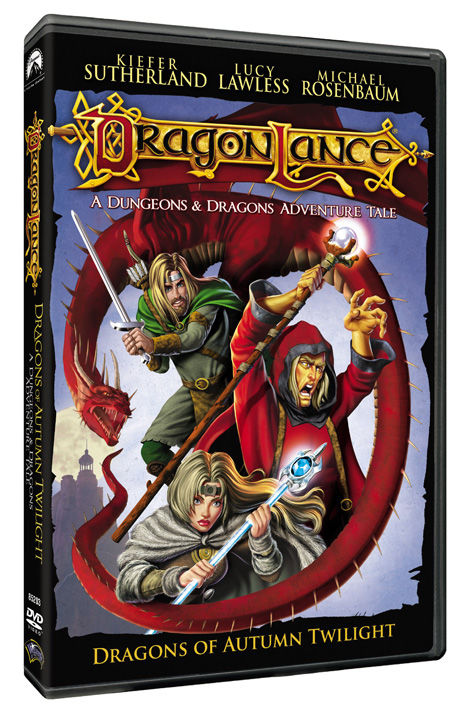
Dragonlance: Dragons of Autumn Twilight


From Dragonlance Movie Site


We're happy to (finally) be able to present the first trailer, shown at GenCon and DragonCon earlier this year. This has been designated a "rough cut" -- the final trailer should be available in the next month or so.

Paramount also provided this statement to accompany the release:

"Dragonlance fans -- We’re sorry that it has taken this long to get a trailer out. We had been waiting in hopes that we could show you the final trailer but unfortunately, due to unforeseen circumstances (i.e. key talent issues etc) we have not been able to cut the final trailer together and get 100% approval. Ever since we showed this piece at GenCon and DragonCon there has been a huge demand to see the trailer so we figured it’d be best to show you the rough version instead of having everyone wait even longer. We appreciate your patience. Enjoy!"

Without further adieu...


Official Release Date:

"Dragonlance: Dragons of Autumn Twilight" will be released on DVD on 15 January 2008!

Pre-order Now


Interview with Shelly Mazzanoble, Author of Confessions of a Part-Time Sorceress


From Cerise Magazine

By Robyn Fleming
After reading her book last month, I contacted Shelly Mazzanoble, author of Confessions of a Part-Time Sorceress: A Girl’s Guide to the Dungeons & Dragons Game and employee of Wizards of the Coast, to ask if she might like to do an interview for Cerise. Happily, her answer was yes. I hope you all will enjoy reading what she has to say as much as I did.


Robyn Fleming: Before I ask you anything else, I have to know – how’s Astrid? Still alive and well?

Shelly Mazzanoble: Yes! Astrid is relaxing on a much-deserved hiatus. In fact, she plans on retiring from this whole adventure business to take up teaching sorcery at the local charm school.

RF: So how did Confessions of a Part-Time Sorceress come about? Did you think you’d be writing a book about it when you first started playing D&D?

SM: If someone told me two years ago that I would write a book about D&D I would have thought it the most preposterous thing I had ever heard. I’m still surprised I wrote a book–let alone a book about D&D. I keep thinking back to that fateful day when Teddy asked me to join the group. What if I had said no?

I was a theater major in college so roleplaying isn’t completely foreign to me and I’ve worked at Wizards long enough to have a basic understanding of what D&D is but even so, I was pleasantly surprised by how much I enjoyed my first few sessions. I wrote an essay for an editor I had worked with at The Seattle Times about “my secret life as a dragon slayer.” Although she was amused, the editor had a hard time grasping the whole “I’ve got a Balenciaga mace and I’m not afraid to use it” story angle. I showed it to some people at work who unbeknownst to me where already exploring ways to reach out to women—gamers and non-gamers. Someone thought my essay could be expanded upon so I wrote up a proposal for a “How to” book written for the woman who has no concept of roleplaying games or the fact you could actually role a fifteen on a single die. Realizing that so much of D&D’s core comes to most women so naturally—storytelling, socializing, even roleplaying—I wanted to highlight that aspect. I tried to write the book that would have helped me learn. A lot of people are turned off by D&D because they think it’s too complicated but it’s really not. I firmly believed that if more women knew what D&D was really about, they’d be inclined to give the old d20 a spin.


RF: What was it like to work on the book? Did you find it very different from your past writing experiences?

SM: One very big difference was that I was writing a book actually scheduled to be published. What a luxury! But I have to say it’s a very odd experience to be writing a book that will be published by the company you work for. It definitely had its advantages like I got to weigh in on selecting the illustrator for the cover and interior art and the marketing team are actually people I play D&D with. Talk about metagaming. How about “Astrid’s going to fireball you in your sleep if she doesn’t get an ad campaign!”

But there is also such as thing as too much information. It’s a fine line between co-worker and ubiquitous, annoying author and one I’m sure I crossed often.


RF: There’s a lot of focus on making D&D more appealing to “girly-girl” types in Confessions – can you explain a little bit about why you think this is important?

SM: My intention was to appeal to all women who have the slightest interest in D&D—girly-girls, girls who like video games but who had never heard of D&D, my friends . . . my mom! I am a girly-girl so that part of me can’t help but seep through. But that’s also just one part of who I am. I volunteer for women’s organizations and animal shelters. I’m a homeowner. I enjoy rearranging my 401K plan almost as much as I do my closets. Almost.

Learning D&D can be information overload so I wanted to outline the basics in an entertaining, less daunting way. I figured comparing daily spells to M&M intake is more entertaining than explaining the game theory behind it.

Sure I said those things in my game about having a designer haversack and getting our food rations at Costco but that was all very tongue in cheek. I know there wasn’t a Cheesecake Factory back in the Middle Ages. Come on! They couldn’t possibly have had enough variety of cheesecake to warrant one.

Read More

Saturday, November 3, 2007

Dread Gazebo

From Dread Gazebo

Part of BlackHammer's adventure in RPG Humour

The Dread Gazebo has earned its place in the canon of gaming legend, along with Phil Foglio's Phil & Dixie strips and Gary Gygax's dice probability charts. So here it is, reprinted with permission (the exact words used were, "use it with my blessing, live long and prosper.")

The Tale of Eric and the Dread Gazebo
by Richard Aronson [aronson@sierratel.com]

In the early seventies, Ed Whitchurch ran "his game", and one of the participants was Eric Sorenson. Eric plays something like a computer. When he games, he methodically considers each possibility before choosing his preferred option. If given time, he will invariably pick the optimal solution. It has been known to take weeks. He is otherwise, in all respects, a superior gamer. Eric was playing a Neutral Paladin in Ed's game. He was on some lord's lands when the following exchange occurred:


ED: You see a well groomed garden. In the middle, on a small hill, you see a gazebo.
ERIC: A gazebo? What color is it?

ED: [pause] It's white, Eric.
ERIC: How far away is it?

ED: About 50 yards.
ERIC: How big is it?

ED: [pause] It's about 30 ft across, 15 ft high, with a pointed top.
ERIC: I use my sword to detect good on it.

ED: It's not good, Eric. It's a gazebo.
ERIC: [pause] I call out to it.

ED: It won't answer. It's a gazebo.
ERIC: [pause] I sheathe my sword and draw my bow and arrows. Does it respond in any way?

ED: No, Eric, it's a gazebo!
ERIC: I shoot it with my bow. [roll to hit] What happened?

ED: There is now a gazebo with an arrow sticking out of it.
ERIC: [pause] Wasn't it wounded?

ED: OF COURSE NOT, ERIC! IT'S A GAZEBO!
ERIC: [whimper] But that was a +3 arrow!

ED: It's a gazebo, Eric, a GAZEBO! If you really want to try to destroy it, you could try to chop it with an axe, I suppose, or you could try to burn it, but I don't know why anybody would even try. It's a @#$%!! gazebo!
ERIC: [long pause. He has no axe or fire spells.] I run away.

ED: [thoroughly frustrated] It's too late. You've awakened the gazebo. It catches you and eats you.
ERIC: [reaching for his dice] Maybe I'll roll up a fire-using mage so I can avenge my Paladin.


At this point, the increasingly amused fellow party members restored a modicum of order by explaining to Eric what a gazebo is. Thus ends the tale of Eric and the Dread Gazebo. It could have been worse; at least the gazebo wasn't on a grassy gnoll. Thus ends the tale of Eric and the Dread Gazebo. A little vocabulary is a dangerous thing.


The above is Copyright © 1989 by Richard Aronson. Reprinted with permission. The author grants permission to reprint as long as all copyright notices remain with the text.


"Eric and the Gazebo" was written and copyrighted by me in 1986. It was based on an event at a role-playing game, but the addition of several jokes moves it out of journalism, or at least into Docuhumor. Some of the people at the game retold the event, each with their own spin, but I was the one who told it to Lee Gold, editor of the fanzine "Alarums and Excursions," who insisted I print it up for her. After reprinting in several amateur publications, it leapt to "The Mensa Bulletin." I then foolishly allowed a reader to reprint it on the internet (who knew from internet in 1989). For many years his was the only interent reprint which even mentioned that there was a copyright on it (thanks, James Chu). Eventually I became a professional game designer for Sierra On-Line and the late lamented "ImagiNation Network" and after having been accused of stealing my own story at a gaming convention I have spend several hours every year protecting my copyright, especially since I incorporated E&tG into a chapter of my as yet unpublished novel. "
Richard Aronson, Feb 15, 2000


Read More

Friday, November 2, 2007

Looking Back at D&D Miniatures


Dragon

Miniatures in the Ancient Times of Role-Playing

by James M. Ward

The year 1974 was one of my luckiest times, because I met Gary Gygax and he kindly asked me over to his house to learn D&D. As a complete stranger, I was warmly welcomed. I sat on his side porch and Brian Blume, Gary's partner in the company, taught me how to roll up a character. I rolled a good Intelligence and Dexterity and made my first, magical character. We sat and played, without using any miniatures, yet I simply can't describe how much fun I had, and continued to have, as the weeks and months went by.

Miniatures filled Gary's house. He liked to play miniature games as well as role-playing ones, and all time periods were represented from ancients to WWII. The medieval wargame rules Chainmail had been published, and the fantasy version was being written and playtested. Miniatures for fantasy games weren't being made in 1974. Scruby wouldn't start his fantasy figures at 30mm until 1975. Ral Partha was just a gleam in Chuck Crane's and Jack Hesselbrock's eyes and wouldn't start until 1975 as well. Grenadier was also a start-up company in that year. All of these companies would end up making wonderful fantasy figures.

I'm not sure which came first, playing with figures in the Boot Hill western RPG or playing with figures in the D&D game. I do, however, have a distinct memory of miniatures in both games. In the D&D game, Gary put out the first bugbear figure. Naturally, as enthusiastic gamers, we all wanted to get in and strike at the monster. Before miniature figures, all six of us would have just swung away. Now that we had figures for our characters and the foes we faced, we realized the difficulty of fighting in close quarters. Our figures showed there wasn't room for all of those warrior and cleric bodies to crowd into the action. Imagine our horror and disgust when only three of us were able to chop at the bugbear. Suddenly, we had to think about tactics. The need to know who did the most damage changed how we played the game.

As a side note, in that early time (1974-75) when there were no commercially-available figures for wizards, dwarves, elves, and halflings, there were plenty of human warriors from historical games. It was possible to approximate dwarves and halflings with 15mm human figures. What there were, however, was lots of fun, plastic Western figures. We had cavalry, Indians, townsfolk, sheriffs, and Texas Rangers. I was just learning how to paint miniatures in those days, and it sure was enjoyable working on my player characters and other figures that I needed for the Boot Hill campaign. I was Don Diego Ward with two sirviente (servant ladies) following me all the time. No one knew until the bullets started flying that those two ladies were greased lightning shots who carried pistols in their clutch purses.

To read more you must be a member of D&D Insider

Read More


Adbrite

Your Ad Here